Title here
Summary here
July 7, 2026 in Releases by David Wiseman3 minutes

Top highlights and notable fixes in DBA Dash 4.14. Includes ScheduleInfo collection and system report conversions
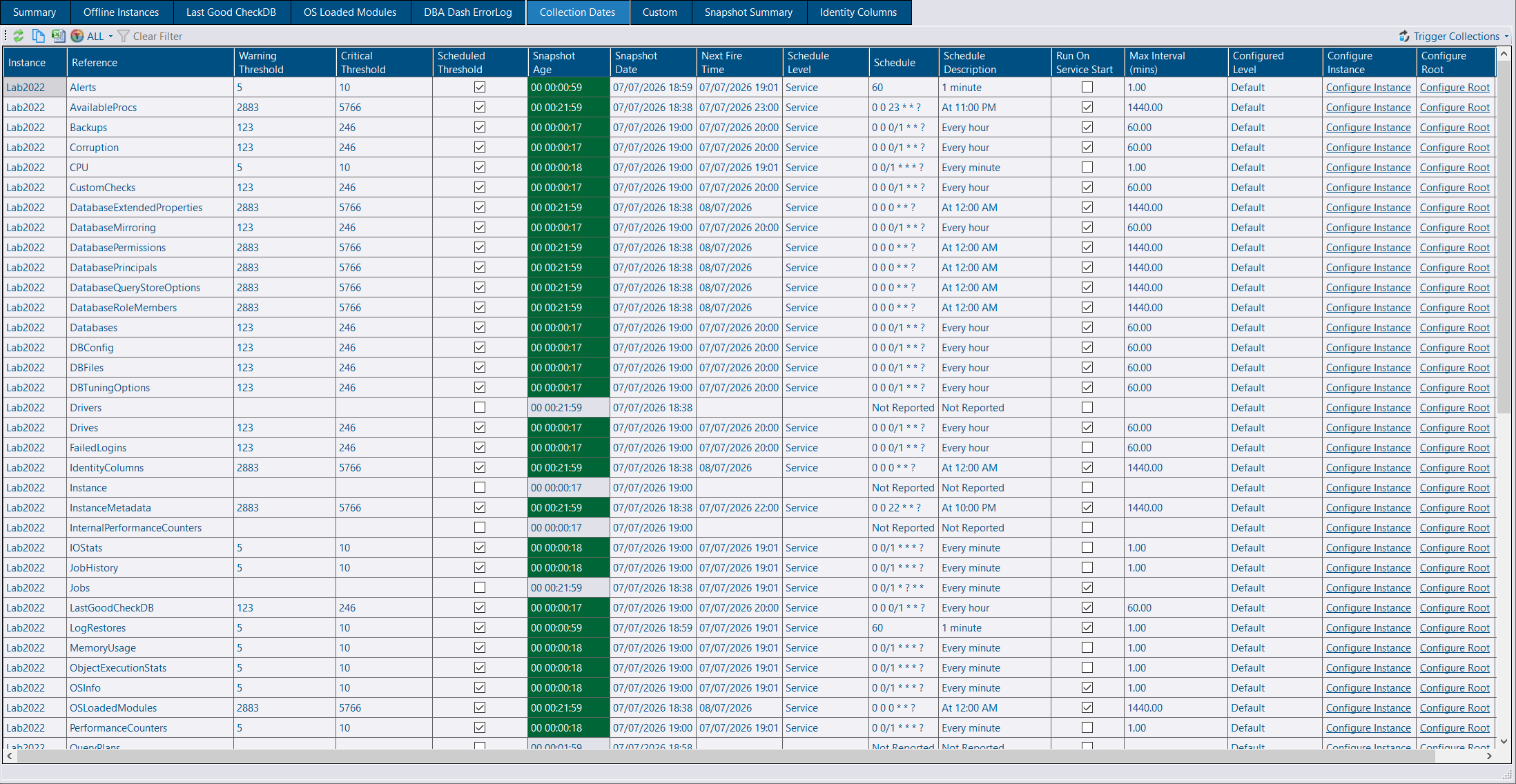
The service now records schedule configuration in the repository database via the ScheduleInfo collection (populated at service start). This enables a few useful improvements:
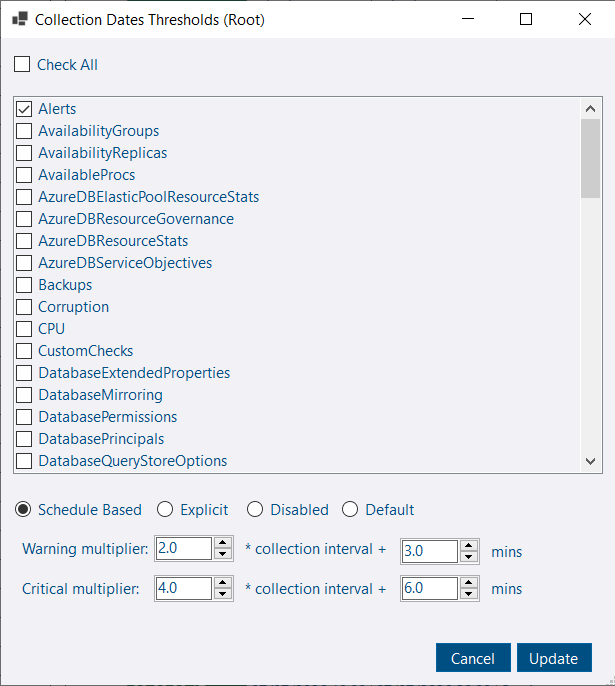
Schedule-based thresholds let you set alerts based on a multiple of the collection frequency plus a fixed buffer. In the example above there is a warning multiplier of 2.0 and a buffer of 3 minutes. Thresholds are calculated from the collection frequency. For example:
If you change the collection frequency in the service configuration tool, thresholds update automatically. Disabling a collection also disables its threshold.
The table below shows the typical thresholds assigned to collections based on frequency and the new schedule-based defaults. The warning threshold will trigger about 3 minutes after missing two collections; the critical threshold about 6 minutes after missing four collections.
| Collection Frequency | Old Warning | New Warning | Old Critical | New Critical |
|---|---|---|---|---|
| 1min | 5min | 5min | 10min | 10min |
| 1hr | 125min | 123min | 180min | 246min |
| daily | 1445min | 2883min | 2880min | 5766min |
During upgrade, old default threshold values are removed automatically as a one-time migration. If you haven’t customized thresholds, you’ll automatically get the new schedule-based thresholds. To restore the old defaults, run the following SQL on the repository database:
INSERT INTO dbo.CollectionDatesThresholds
(
    InstanceID,
    Reference,
    WarningThreshold,
    CriticalThreshold
)

SELECT T.InstanceID,
       T.Reference,
       T.WarningThreshold,
       T.CriticalThreshold
FROM
(VALUES
(-1,'DBFiles',125,180),
(-1,'ServerExtraProperties',125,180),
(-1,'OSLoadedModules',1445,2880),
(-1,'TraceFlags',125,180),
(-1,'ServerProperties',125,180),
(-1,'LogRestores',125,180),
(-1,'DatabasesHADR',5,10),
(-1,'LastGoodCheckDB',125,180),
(-1,'Alerts',125,180),
(-1,'DBTuningOptions',125,180),
(-1,'DBConfig',125,180),
(-1,'OSInfo',5,10),
(-1,'Drives',125,180),
(-1,'Databases',125,180),
(-1,'Instance',125,180),
(-1,'Drivers',1445,2880),
(-1,'SysConfig',125,180),
(-1,'Backups',125,180),
(-1,'AzureDBServiceObjectives',125,180),
(-1,'Corruption',125,180),
(-1,'RunningQueries',5,10),
(-1,'CPU',5,10),
(-1,'IOStats',5,10),
(-1,'ObjectExecutionStats',5,10),
(-1,'SlowQueries',5,10),
(-1,'SlowQueriesStats',5,10),
(-1,'AzureDBElasticPoolResourceStat',5,10),
(-1,'Waits',5,10),
(-1,'AzureDBResourceStats',5,10),
(-1,'DatabasePrincipals',1445,2880),
(-1,'ServerPermissions',1445,2880),
(-1,'ServerPrincipals',1445,2880),
(-1,'DatabasePermissions',1445,2880),
(-1,'ServerRoleMembers',1445,2880),
(-1,'DatabaseRoleMembers',1445,2880),
(-1,'DatabaseMirroring',125,180),
(-1,'Jobs',1445,2880),
(-1,'JobHistory',5,10),
(-1,'VLF',1445,2880),
(-1,'CustomChecks',125,180),
(-1,'PerformanceCounters',5,10),
(-1,'DatabaseQueryStoreOptions',1445,2880),
(-1,'AzureDBResourceGovernance',125,180),
(-1,'ResourceGovernorConfiguration',1445,2880),
(-1,'MemoryUsage',5,10),
(-1,'IdentityColumns',10080,20160),
(-1,'RunningJobs',5,10),
(-1,'TableSize',4320,11520),
(-1,'ServerServices',1445,2880),
(-1,'FailedLogins',1445,2880),
(-1,'ResourceGovernorWorkloadGroups',5,10)
) T(InstanceID,Reference,WarningThreshold,CriticalThreshold)
WHERE NOT EXISTS(SELECT 1 FROM dbo.CollectionDatesThresholds CDT WHERE CDT.InstanceID = T.InstanceID AND CDT.Reference = T.Reference)
Note: The new default values will apply to any collection type that reports a schedule. This includes custom collections.
This release adds additional custom report conversions:
Converting these tabs to system reports simplifies the codebase and enables them to benefit from custom report features, such as triggering collections and opening in a new window.
See the 4.14.0 release notes for a full list of fixes and improvements.